


by First Give
St Albans Students Tackle Tough Issues with Courage and Creativity
Year 9 students impressed judges including Daisy Cooper MP with powerful presentations on knife crime, domestic abuse, and human trafficking

Friday 15 May 2026 marked a powerful moment at St Albans Girls’ School, as eight groups of Year 9 students delivered presentations on some of society’s most challenging issues.
The Final showcased the impact of the First Give programme – where students research local charities, design projects to support them, and present their work to judges and peers. But what made this year’s Final particularly striking was the courage with which students confronted difficult subjects.
Groups tackled knife crime, domestic abuse, human trafficking, and support for young carers. And they didn’t hold back. Their presentations were creative, well-researched, and genuinely moving.
A Moment That Will Stay With You
The judging panel – which included Daisy Cooper MP (Deputy Leader of the Liberal Democrats), Councillor Teresa Heritage (Mayor of St Albans), and Mr Paul Kershaw (Headteacher) – were visibly impressed.
Daisy Cooper highlighted one particularly striking moment: “Three different groups asked people in the audience to stand up as a proportion – asking one in four young women to stand up as representation of statistically how many young women might be victims of domestic abuse and violence in the future. That will probably stay with me. It’s quite a strong visual sign, and I think it was very powerful.”
She went on to commend all the students: “The presenting students didn’t shy away from some really, really difficult issues, around knife crime and sexual assault. I think it was incredibly powerful of them to choose such topics and to invest their energy in them.”
The Winning Group: Charlie’s Promise
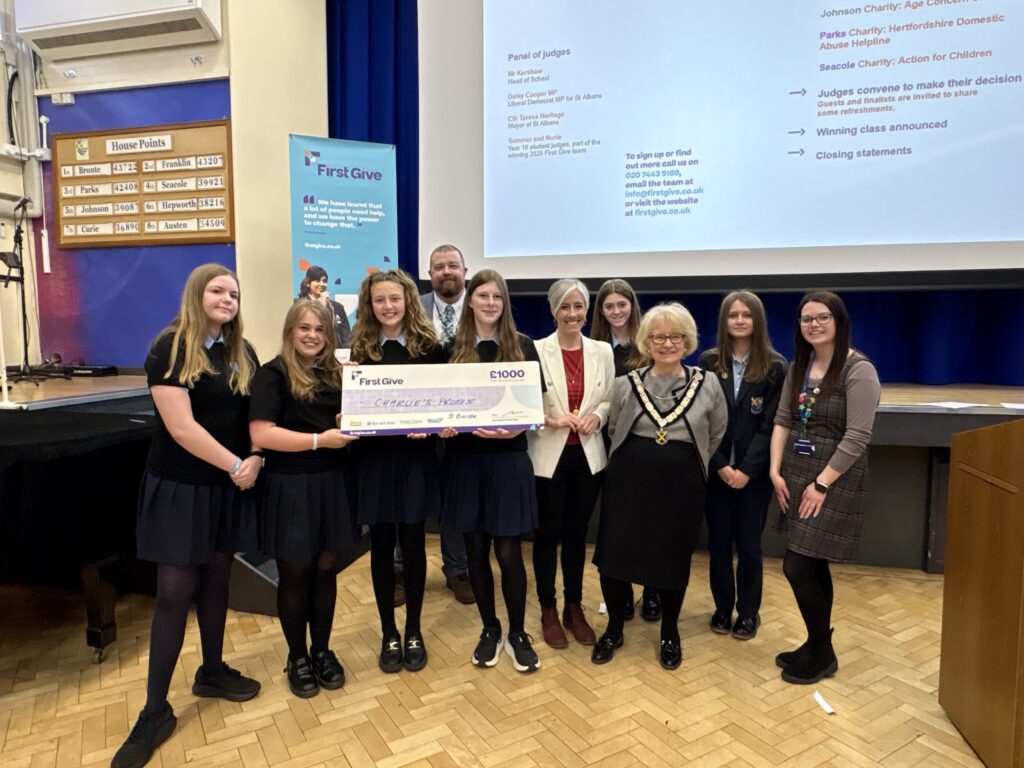
The winning group, 9 Bronte, secured £1,000 for Charlie’s Promise, a charity raising awareness about knife crime.
Their campaign was creative and multi-faceted:
- A quiz measuring awareness before and after their activities
- Football keepy-uppy challenges commemorating Charlie’s love of football
- Origami hearts resembling the charity’s logo
- A “guess the sweets” challenge where the number represented a knife crime statistic
One of the winning groups students explained the impact: “They’re quite a small charity, so they never get this big an opportunity. In our presentation we mentioned that they’re making a 45-minute educational video, which is what a lot of the £1,000 will hopefully help them to do.”
When asked if they’d continue supporting the charity, another member of the winning groups response was immediate: “I think we will definitely carry on spreading more awareness about this charity. I love this charity. I feel like I’ve built something special with it now.”
Why This Matters Beyond the Classroom
Mr Paul Kershaw, Headteacher, captured something fundamental about the First Give programme: “My favourite thing about the First Give project is that it doesn’t only give students a sense of the kind of charities and vocations available to them, but also the oracy skills, public speaking, teamwork, research and ways of thinking outside of the box. All of that done for the charities alone rather than towards a GCSE or an A level – I think is absolutely invaluable for them to experience.”
Councillor Teresa Heritage added: “I thought it was amazing the subjects and charities that students chose. Several groups particularly highlighted something that young people might not know about, which is really important. It’s learning what’s actually out there that can impact upon them.”
Building Real Connections
What impressed us most was seeing students understand something profound: that they have agency. That their voices matter. That they can make a real difference.
As ever a student summed it up perfectly “It’s definitely important that all people are heard in general. So, like, as young people, it is good to know that our voices matter.”
These students didn’t just learn about charities – they built genuine relationships with them. They experienced what it feels like to research an issue, design a solution, and see people respond. They discovered their power to create change.