

by First Give
Blue Monday and Youth Mental Health
Head of Programmes, Michael Anderson, reflects on how the First Give programme helps young people move beyond slogans and towards action on youth mental health
Every January, right on schedule, Blue Monday rolls back into our feeds. The third Monday of the month, we’re told, is the most depressing day of the year: a miserable mishmash of dark mornings, bills, broken resolutions, ads for SAD lamps… the emotional tail of winter.
The idea itself is not quite what it pretends to be. Blue Monday was invented in 2005 by a UK travel company, backed by a formula so pseudo its creator has since apologised. There’s something faintly comic here – feel sad, buy holiday. (Come back 2005, all is forgiven.) It also speaks to a culture, fragmented and digitised, grown excellent at flipping emotional difficulty and mental health into content, while at once exacerbating the problem.
But here’s the rub: people really do feel low in January. Whether you’re counting the approx. 17 years to the next payday or getting back to the pressurised grind of GCSEs, winter can feel long, the year ahead exhausting before it’s even begun. (I remember reaching noon on 5th and feeling staggered that a bluer Monday was only a fortnight away.)
All of which brings us to the 2024–25 First Give programme, when more than 37,000 young people across England and Wales identified social issues that mattered to them, and did something about it. The most ‘popular’ issue chosen? Mental health, chosen by one in five classes. This is not a January trough or marketing ploy: it is a generation telling us what weighs heavily on them. The statistic also mirrors something else we know, that around 20% of young people experience mental health problems.
Young people are not just learning about mental health in the abstract; many are living with it, personally or through watching friends and family struggle. Anxiety, low mood, eating disorders, self-harm, and loneliness are not fringe issues in schools, and so when Blue Monday invites a collective, performative gloom, it risks flattening something complex and serious. This is why young people’s focus on mental health through First Give is both so striking and so hopeful. They are not waiting for a designated day to talk about it – they are choosing it because it feels urgent to them, and they want to do something about it.
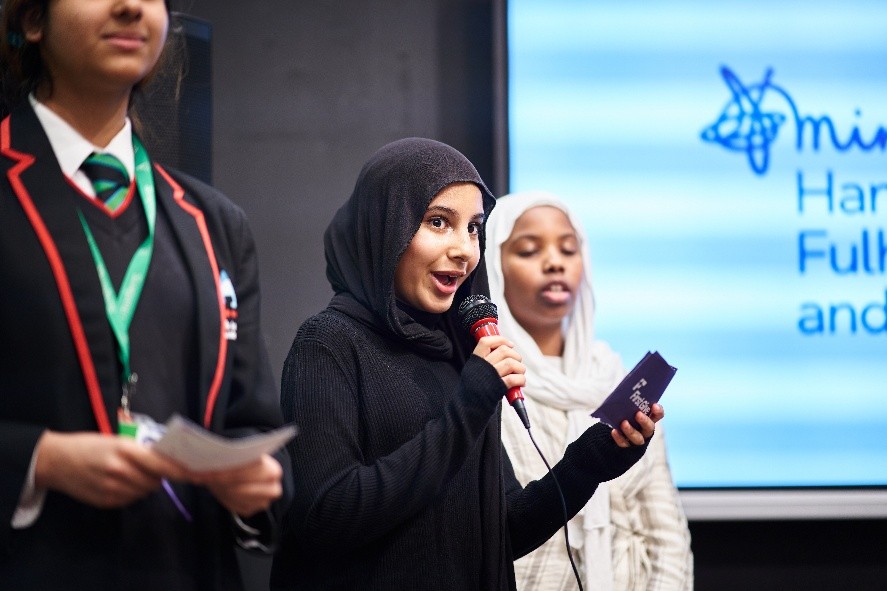
A First Give participant representing the mental health charity Mind
There is something reassuring here. Young people are not asking for slogans or awareness campaigns. What they want is improved counselling in schools, or youth clubs that don’t close, or a social media space where the echoes say nice things. In connecting with charities working in the issues they choose, students realise they have a voice to let people know this, and to make a difference themselves through their social action.
This is why young people’s focus on mental health through First Give is both so striking and so hopeful. They are not waiting for a designated day to talk about it – they are choosing it because it feels urgent to them, and they want to do something about it.
Michael Anderson, First Give Head of Programmes
That matters because one of the most damaging things about mental health struggles is isolation, but when one in five classes chooses mental health as their cause, students realise they are not alone. They are seen and heard.
A charity First Give has worked alongside with increasing frequency is Rethink Mental Illness, a leading charity provider of mental health services in England. Hannah Nutt, Senior Events Community Fundraising Manager, shared the following reflection on the students’ choice:
“It so important to start conversations about mental health early. One in five children and young people in the UK now has a probable mental health condition and waiting lists for support are growing. That’s why our work in schools alongside First Give is so powerful: not only introducing them to the charity sector and showing how they can shape positive change in their communities, but helping young people understand mental health, challenge stigma and know where to turn for support.”
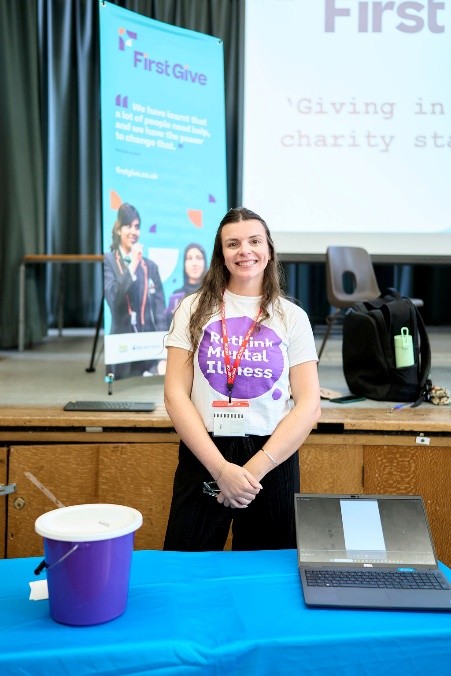
Rethink Mental Illness Senior Events Community Fundraising Manager Hannah Nutt
I’m conscious of the hypocrisy of using Blue Monday’s existence to make a point about Blue Monday not needing to exist – rest assured, I am a sucker for any content that makes me laugh or think or want to go to a sauna or jump in cold water. The issue is that BM in particular presents a wafer-thin version of empathy (even by social media’s standards) and can frequently turn emotional difficulty into a seasonal gripe, rather than an ongoing responsibility.
Monday will come and go, as it always does. But the 20% of young people struggling with their mental health will still be here on Tuesday – and next week – and July – and the rest of the year. The fact that so many young people are choosing to confront that through First Give is not depressing at all. It’s quietly powerful, and we are proud to support them.
By Michael Anderson- First Give Head of Programmes